Episode 39: This Desire that You Are: Kenneth Novis on Spinoza
“Spinoza’s universe is crisscrossed by flows of power like tides that sweep into space before departing.”
This sentence, from a talk Kenneth Novis recently gave about Gilles Deleuze and Baruch Spinoza (1632-1677) frames our conversation about Spinoza’s theories of God-nature-substance, virtue and ethics, power, self-contentment, joy, sadness and especially desire.
We begin with Kenneth’s education in Edinburgh and Oxford, his work on Spinoza, Simone Weil, Deleuze and Bayle. After briefly discussing the ideological stranglehold on the study of Marxism in the UK and the special brilliance of twelve-year-olds, we turn to Spinoza’s biography—his early life in the Sephardic Jewish community of Amsterdam, the writ of herem against him, and his subsequent life spent mostly in solitude in The Hague. We touch on the question of whether Spinoza was a theist, a pantheist, or an atheist and we query the influence of Maimonides and Kabbala on his thinking. In the second half of the conversation Kenny explains that for Spinoza, desire (which for him can be objectless!) is both one of the primary affects and our essence. We “undergo desire “but “it is also what we are, it is our essence.” Not only this, desire is also the essence of all things, from animals to trees to even chunks of granite! How might ethics or virtue derive from such a capacious understanding of desire and its status?
This episode was recorded during the day before Yom Kippur. For this reason, we end with Ben playing Kol Nidre.
Texts / scholars mentioned and discussed:
A Philosopher and a Child: Does Infinity Exist? (warning: if you click on this you might not be able to leave)
Louis Althusser on Spinoza
Pierre Bayle An Historical and Critical Dictionary (small correction: Bayle’s dictionary was published in 1697, not 99 as stated.)
Simone Weil First and Last Notebooks
René Descartes Principles of Philosophy
Alexander Douglas The Philosophy of Hope: Beatitude in Spinoza
Gilles Deleuze and Felix Guattari Anti-Oedipus: Capitalism and Schizophrenia
Music by Ben Roberts : Benjamin.Roberts447@gmail.com
Comments and ideas to Juliealicecarr@gmail.com
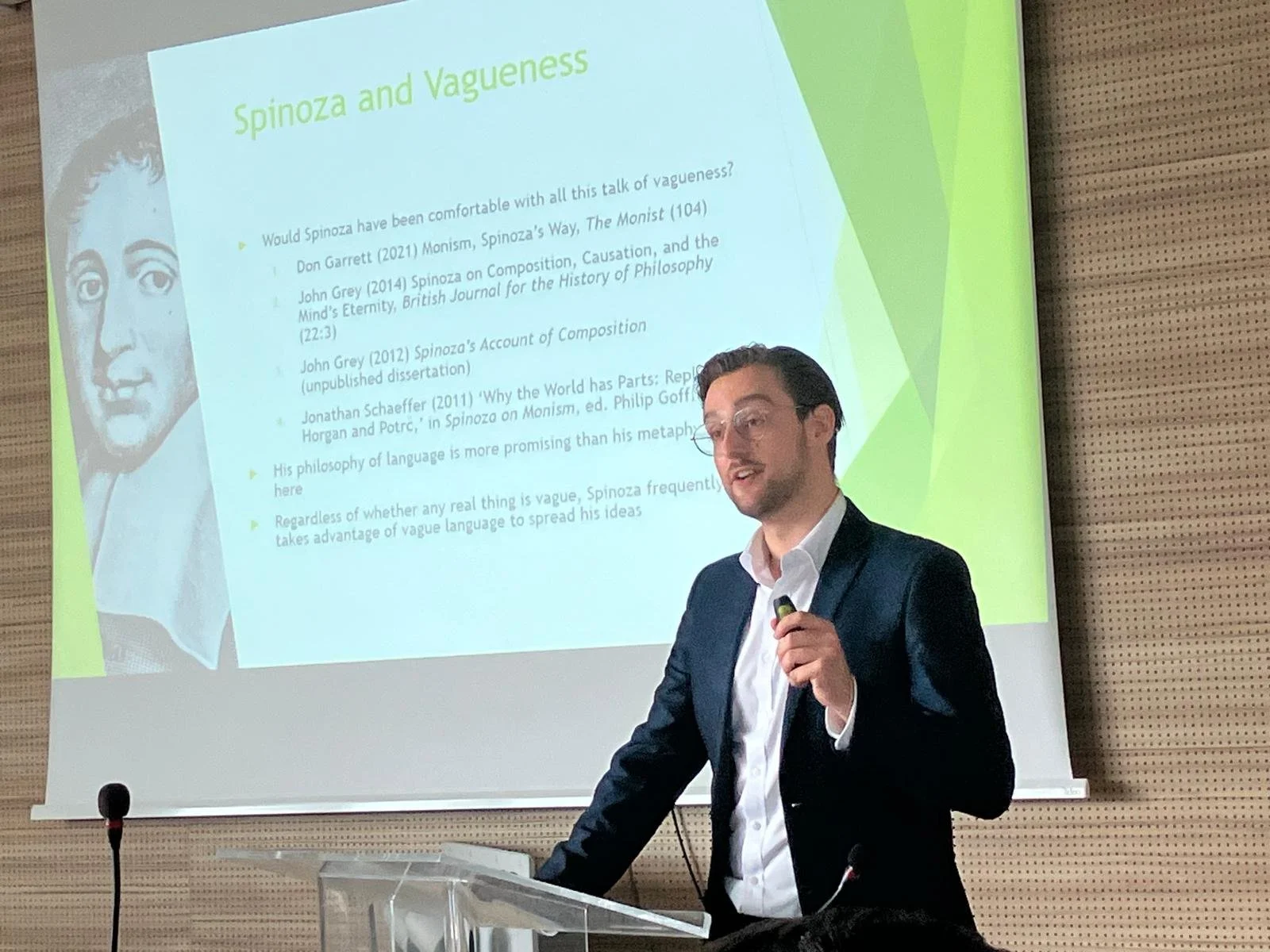
Kenneth Novis
Kenneth Novis is a D.Phil (PhD) candidate in Philosophy at the University of Oxford. He specialises in early modern moral philosophy, with a focus on Benedict Spinoza and Pierre Bayle. His writing has also appeared in The Routledge Companion to Simone Weil, Philosophy Now, Social Epistemology, and the Marx & Philosophy Review of Books.

Return the Key
Jewish Questions for Everyone
